Why You're Seeing "DOCOMO*" on Your Bank Statement
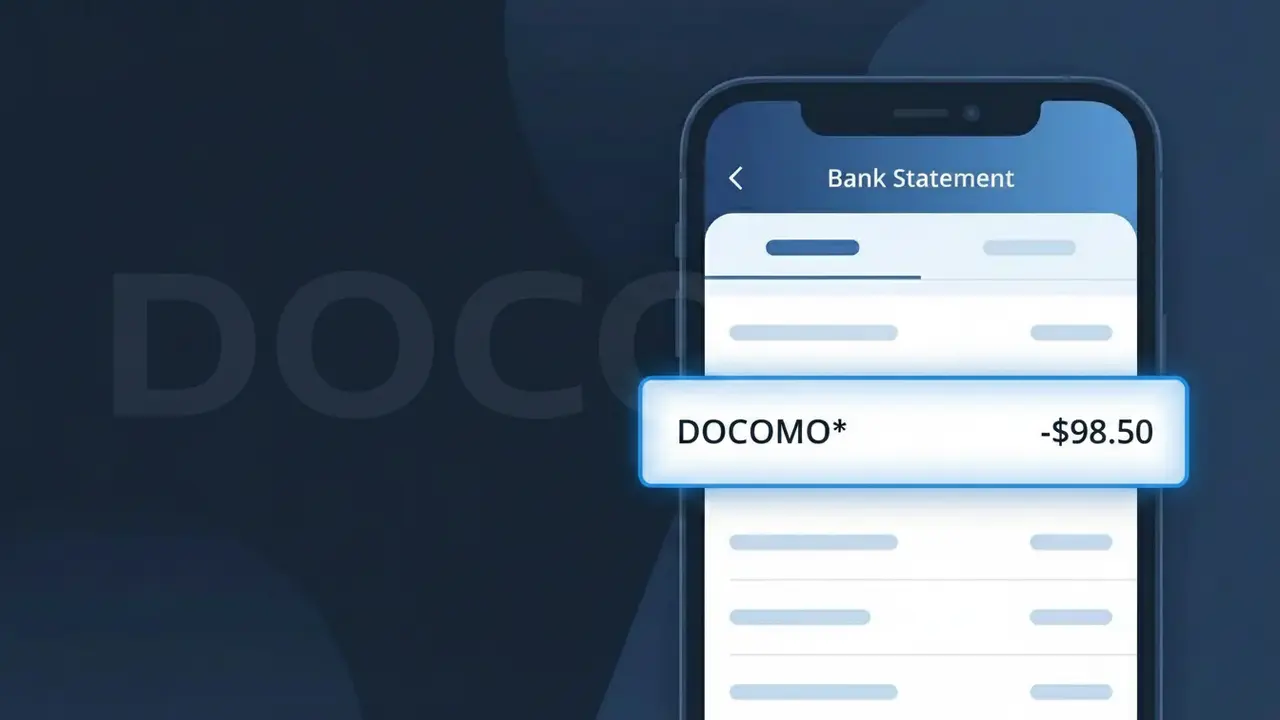
Why You're Seeing "DOCOMO*" on Your Bank Statement
A charge showing DOCOMO* on your bank or credit card statement comes from NTT Docomo, Japan's largest mobile telecommunications provider. This charge typically represents your monthly mobile phone bill, including voice, data, and any additional services on your Docomo plan. NTT Docomo is a subsidiary of NTT (Nippon Telegraph and Telephone) and serves tens of millions of subscribers across Japan. If you have a Japanese mobile contract or have signed up for a Docomo service, this recurring charge is almost certainly your regular monthly bill.
The abbreviated descriptor DOCOMO* appears on bank statements because payment processors truncate merchant names to fit within standard character limits used by card networks like Visa and Mastercard. NTT Docomo uses this shortened billing identifier so that charges are consistently recognized across different financial institutions and statement formats. The asterisk (*) following DOCOMO often indicates that additional billing detail, such as a sub-account number or service code, may follow depending on your bank's display settings.
Is the DOCOMO* Charge Legitimate or Fraud?
The DOCOMO* charge on your bank or credit card statement is most commonly a legitimate billing from NTT Docomo Japan, one of Japan's largest mobile telecom providers. This charge typically appears when you have an active Docomo mobile plan, digital content subscription, or have made a purchase through the Docomo d-Market platform. However, if you have no connection to Japan or NTT Docomo Japan services, it is worth investigating further.
- Active NTT Docomo Japan mobile phone plan or SIM card subscription
- Purchase or recurring subscription via Docomo's d-Market, d-Anime, or d-Music services
- Roaming or travel SIM purchased from NTT Docomo Japan for a Japan trip
- Unauthorized use of your card details by a third party mimicking Docomo billing
How to Verify the DOCOMO* Charge
- 1
Log into your NTT Docomo Japan account
Visit the official My Docomo portal at mydocomo.com and review your billing history for charges matching the DOCOMO* amount and date on your statement.
- 2
Search your email for NTT Docomo Japan receipts
Search your inbox for emails from NTT Docomo Japan using keywords like 'Docomo', 'ドコモ', or 'NTT'. Receipts or subscription confirmation emails often arrive around the billing date.
- 3
Check with household or travel companions
Ask family members or travel companions if they signed up for a Docomo SIM, data plan, or digital service and used your shared payment card for the DOCOMO* charge.
- 4
Review your active digital subscriptions
NTT Docomo Japan offers streaming and content services like d-Anime Store and d-Music. Check whether you enrolled in a free trial that has since converted to a paid DOCOMO* billing.
- 5
Contact your bank for transaction details
Call the number on the back of your card and ask for the full merchant descriptor and transaction ID associated with the DOCOMO* charge to help pinpoint its origin.
How to Dispute a DOCOMO* Charge
- 1
Act within 60 days of the charge
Most banks require disputes to be filed within 60 days of the DOCOMO* charge appearing on your statement. Acting quickly preserves your right to a full chargeback.
- 2
Contact NTT Docomo Japan customer support first
Reach NTT Docomo Japan via their official support site or international helpline. Resolving the DOCOMO* charge directly with Docomo is often faster than a bank dispute.
- 3
File a chargeback with your bank or card issuer
If NTT Docomo Japan does not resolve the issue, contact your card issuer, explain that the DOCOMO* charge is unauthorized, and formally request a chargeback with any supporting documentation.
- 4
Request a new card number if fraud is suspected
If you believe the DOCOMO* charge is the result of card fraud, ask your bank to cancel your current card and issue a new one to prevent additional unauthorized charges from NTT Docomo Japan or others.
Tips for Managing NTT Docomo Japan Charges
Set a bank alert for any DOCOMO* charge so you're notified the moment NTT Docomo Japan bills your card.
Keep a record of all NTT Docomo Japan service agreements and confirmation emails in a dedicated folder.
Secure your NTT Docomo Japan My Docomo account with a strong password and two-factor authentication to prevent unauthorized access.
Note that NTT Docomo Japan typically bills on a monthly cycle — cross-check DOCOMO* charges against your plan renewal date.
Use a virtual card number for NTT Docomo Japan subscriptions to limit exposure if your details are ever compromised.
Use WhatIsThisCharge.net to identify related charges that may appear alongside DOCOMO* on your statement.
Frequently Asked Questions About the DOCOMO* Charge
ℹ️ Note
In most cases, a DOCOMO* charge simply reflects an active mobile plan, travel SIM, or digital content subscription with NTT Docomo Japan — a trusted and regulated telecom provider. If you recently visited Japan or signed up for a Docomo service, this charge is very likely legitimate and expected.
Was this article helpful?