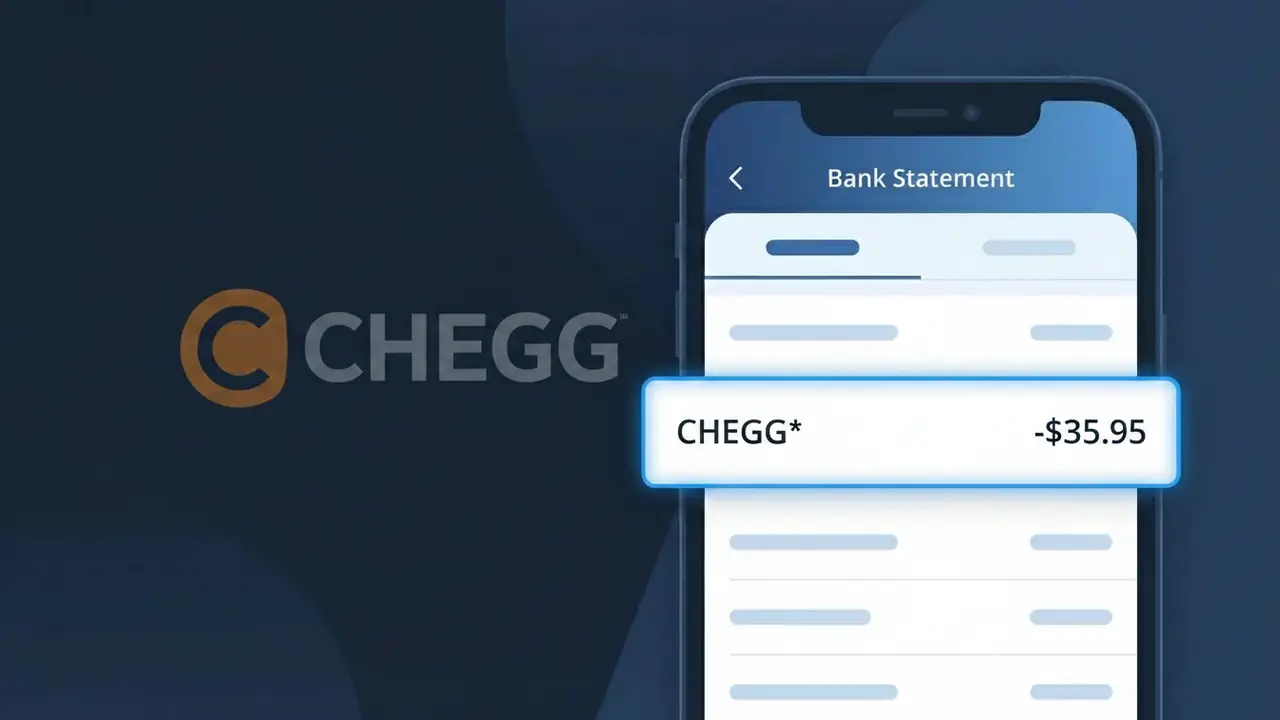
CHEGG* Charge (What It Is + Is It Legit?)
✓ LegitimateThe "CHEGG*" charge is from Chegg. Chegg student learning subscription.
Chegg
Chegg student learning subscription.
Category
Education
Avg. Charge
$14.95
Country
US
Billing Cycle
Monthly
Cancel At
chegg.com/account
Support
See website
What is this charge?
Chegg uses the truncated descriptor "CHEGG*" on bank statements because their subscription billing system follows a common payment processing convention where an asterisk is appended to the merchant name to signal a recurring charge, helping payment networks distinguish ongoing subscriptions from one-time purchases. This format is applied automatically by Chegg's payment processor when the monthly fee of $14.95 is collected for their student learning platform, which offers textbook rentals, tutoring, and homework help. If you recognize signing up for Chegg's services, this descriptor is simply how that subscription appears in your transaction history rather than any indication of an unauthorized charge.
How to handle this charge
Identify the Chegg subscription
The CHEGG* charge on your bank statement is associated with a Chegg student learning subscription. Log in to your Chegg account at chegg.com to confirm which subscription plan you are currently enrolled in and verify the billing amount matches what you were charged.
Check your Chegg billing history
Once logged in to chegg.com, navigate to your account settings and review your billing history to ensure the CHEGG* charge matches the expected subscription cost and billing date. This helps confirm the charge is not a duplicate or an unexpected price change.
Manage or cancel your Chegg subscription
If you no longer need the Chegg service or did not intend to be billed, visit chegg.com/account to manage your subscription. From there you can update your plan, pause service, or cancel your Chegg subscription to prevent future CHEGG* charges from appearing on your statement.
Contact Chegg support if needed
If the CHEGG* charge amount looks incorrect or you have trouble managing your subscription at chegg.com/account, reach out to Chegg customer support directly through chegg.com for clarification. Have your billing date and charge amount ready to help the support team quickly locate your account and resolve any billing concerns.
How to cancel Chegg
Chegg bills you Monthly. To stop future charges, cancel from your account directly.
Cancel at CheggQuick fraud check
No, this is a legitimate charge from Chegg. However, if you did not authorize this charge or cancelled your subscription, you may be eligible for a refund.
Is the CHEGG* Charge Legitimate or Fraud?
A CHEGG* charge on your bank or credit card statement is most commonly a legitimate billing from Chegg, a popular online education platform offering textbook rentals, homework help, tutoring, and subscription study tools. If you or someone in your household is a student, this charge is very likely tied to an active Chegg subscription or a one-time service purchase. However, if the charge is unexpected, it's worth investigating before assuming it's fraudulent.
- Chegg Study subscription billed monthly or annually under the descriptor CHEGG*
- Chegg textbook rental charges or digital textbook access fees
- A free trial that automatically converted to a paid Chegg subscription
- A family member or student in your household signed up for Chegg services using your payment method
How to Verify the CHEGG* Charge
- 1
Log into your Chegg account
Visit chegg.com and sign in to check your subscription status and billing history. The amount on your statement should match a recent Chegg invoice shown in your account settings.
- 2
Search your email for Chegg receipts
Search your inbox for emails from 'chegg.com' or 'noreply@chegg.com'. Chegg sends confirmation emails for every subscription charge and purchase, so a matching receipt is a strong sign the CHEGG* charge is legitimate.
- 3
Check with household members
Ask students or family members if they signed up for Chegg Study, Chegg Tutors, or a textbook rental using your card. CHEGG* charges often appear unexpectedly when a student uses a shared payment method.
- 4
Review your active subscriptions
Check your bank or card's subscription tracker for recurring CHEGG* charges. A consistent monthly or annual amount typically indicates an ongoing Chegg Study or Chegg Writing subscription.
- 5
Contact your bank for details
If you still can't identify the CHEGG* charge, ask your bank for the full merchant descriptor and transaction date. This can help you pinpoint which Chegg service was billed and when.
How to Dispute a CHEGG* Charge
- 1
Act within 60 days
Most banks require you to dispute an unrecognized CHEGG* charge within 60 days of the statement date. Gather your Chegg account details and the exact charge amount before contacting anyone.
- 2
Contact Chegg customer support first
Reach out to Chegg directly at chegg.com/support or via their live chat. Chegg's support team can clarify what the CHEGG* charge was for and may issue a refund if it was a billing error or unauthorized charge.
- 3
File a chargeback with your bank
If Chegg cannot resolve the issue, contact your bank or card issuer to dispute the CHEGG* charge as unauthorized. Provide any email correspondence with Chegg to strengthen your chargeback claim.
- 4
Request a new card number
If you believe your card details were used fraudulently to sign up for Chegg, ask your bank to issue a new card number. This prevents any further unauthorized CHEGG* charges from recurring.
Tips for Managing Chegg Charges
Enable email alerts from Chegg so you're notified before each CHEGG* renewal charge hits your card.
Save all Chegg receipts and subscription confirmation emails to easily match future CHEGG* charges.
Secure your Chegg account with a strong password to prevent unauthorized subscriptions billed as CHEGG*.
Note your Chegg billing cycle date so you expect the CHEGG* charge and aren't caught off guard each month.
Use a virtual card number for Chegg subscriptions to limit exposure if your payment details are compromised.
Use WhatIsThisCharge.net to identify related charges that may appear alongside CHEGG* on your statement.
ℹ️ Note
In most cases, a CHEGG* charge is a legitimate and expected billing from Chegg for an active student subscription or textbook service — often placed by a student who simply forgot they signed up. A quick check of your Chegg account or household members' activity is usually all it takes to explain the charge.
Frequently Asked Questions
Was this page helpful?
Community Reports (0)
0 votesNo votes yet — be the first to report on this charge!
Have you seen this charge? Help others by voting:
Community Comments (0)
No comments yet. Be the first to share your experience!
Share your experience
Your email is only used to verify your comment and will never be shown publicly.
Search Another Charge
Popular Charges

Amazon Marketplace
AMZN MKTP US
Netflix
NETFLIX *SUBSCRIPTION
Netflix
NETFLIX.COM *
Apple
APPLE *SUBSCRIPTION
Apple
APPLE.COM/BILL
Related Charges
Need to dispute this charge?
Generate a professional dispute letter in seconds with our AI tool.
Open Charge AssistantCommunity Verified
Real user reports
Free to Use
Always free to check
Secure & Private
Your data is safe
Help Millions
48K+ charges identified