Why You're Seeing "HRBLOCK*" on Your Bank Statement
Why You're Seeing "HRBLOCK*" on Your Bank Statement
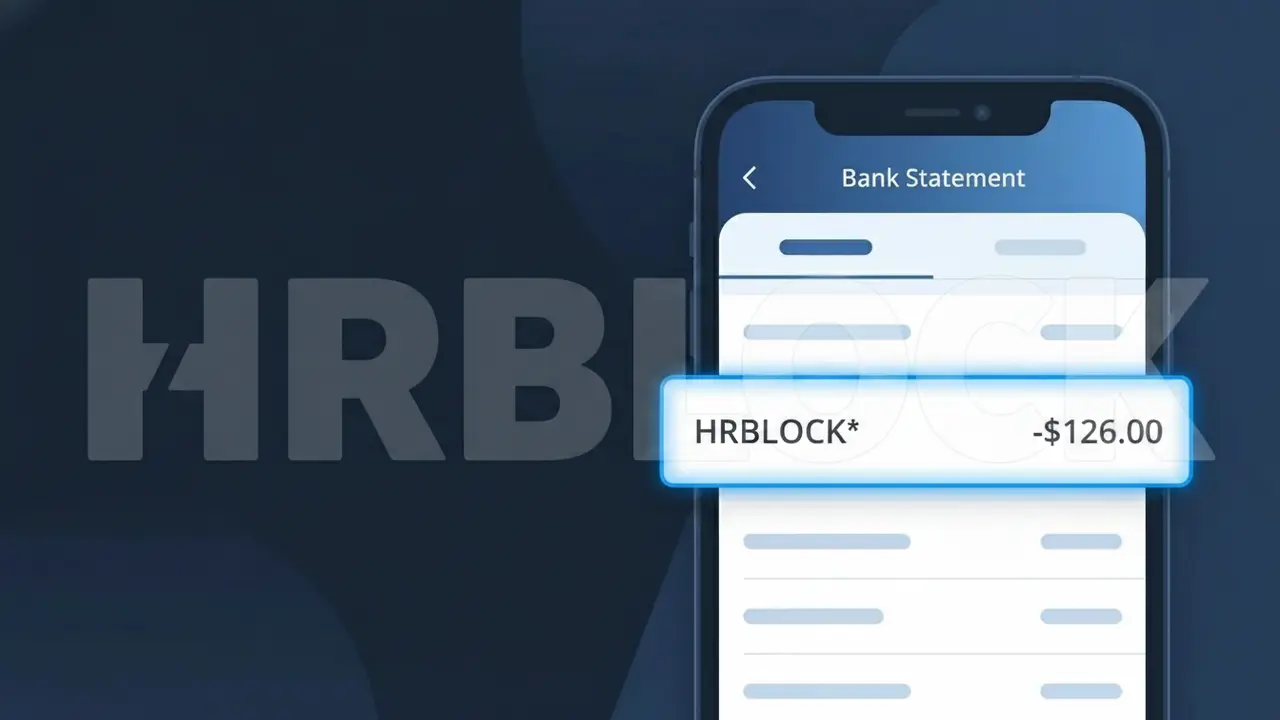
A charge labeled HRBLOCK* on your bank statement comes from H&R Block, one of the largest tax preparation companies in the United States. This charge typically appears when you've paid for tax filing services, either in-person at an H&R Block office or through their online tax preparation software. The asterisk following HRBLOCK* often indicates an additional detail such as a transaction ID or service type may follow depending on your bank's display format. If you recently filed your taxes or purchased a tax-related product through H&R Block, this is almost certainly the source of that charge.
The descriptor HRBLOCK* appears on your bank statement because payment processors use shortened merchant codes to identify transactions, and H&R Block's billing system submits charges under this abbreviated identifier. Many large companies use truncated versions of their name to fit within the character limits imposed by card networks like Visa and Mastercard. The asterisk in HRBLOCK* is a common separator used by payment processors to append additional transaction details such as a location code or service reference number.
Is the HRBLOCK* Charge Legitimate or Fraud?
The HRBLOCK* charge on your bank or credit card statement is most commonly a legitimate transaction from H&R Block, the well-known tax preparation company. It typically appears when you've paid for tax filing services, software, or an active H&R Block subscription plan. Common reasons you might see this charge include:
- Payment for H&R Block online or in-office tax preparation services
- Purchase of H&R Block tax software (desktop or digital download)
- Enrollment in H&R Block's Tax Pro Review or Peace of Mind services
- An annual renewal of an H&R Block subscription or add-on product
How to Verify the HRBLOCK* Charge
- 1
Log into your H&R Block account
Visit hrblock.com and sign in to review your purchase history and any active services. Your billing summary will list all transactions that generate an HRBLOCK* charge.
- 2
Search your email for H&R Block receipts
Search your inbox for emails from H&R Block (noreply@hrblock.com or similar). Receipts for tax filings, software, or add-ons are typically emailed immediately after purchase.
- 3
Check household members
Ask family members if they used your card to pay for H&R Block tax services or software, as shared household finances can lead to unexpected HRBLOCK* charges.
- 4
Review active subscriptions
Check whether you signed up for H&R Block's Tax Identity Shield or a Protection Plus plan, both of which can generate recurring HRBLOCK* charges on an annual basis.
- 5
Contact your bank for details
If you still can't place the HRBLOCK* charge, call your bank and request the full merchant descriptor and transaction date to help narrow down the specific H&R Block product or service purchased.
How to Dispute a HRBLOCK* Charge
- 1
Act within 60 days
Most banks require you to dispute an unrecognized HRBLOCK* charge within 60 days of the statement date. Act quickly to protect your right to a full chargeback.
- 2
Contact H&R Block directly first
Call H&R Block customer support at 1-800-472-5625 or use their online chat. H&R Block can often resolve billing errors or issue refunds faster than a formal bank dispute.
- 3
File a chargeback with your bank
If H&R Block does not resolve the issue, contact your bank or credit card issuer to file a formal chargeback for the HRBLOCK* charge. Provide any email receipts or correspondence as evidence.
- 4
Request a new card if fraud is suspected
If you believe the HRBLOCK* charge is the result of unauthorized card use or identity theft, ask your bank to cancel your current card and issue a new one with a different number.
Tips for Managing H&R Block Charges
Set a bank alert for any HRBLOCK* charge so you're notified the moment H&R Block bills your card.
Save your H&R Block filing confirmation emails as proof of purchase in case you need to dispute an HRBLOCK* charge later.
Keep your H&R Block account login updated so you can quickly access billing history when an HRBLOCK* charge appears.
Note that H&R Block renewal charges often appear in January or February — mark your calendar to anticipate annual HRBLOCK* billing.
Review H&R Block's refund policy before tax season; most software purchases have a limited refund window after filing.
Use WhatIsThisCharge.net to identify related charges that may appear alongside an HRBLOCK* transaction.
Frequently Asked Questions About the HRBLOCK* Charge
ℹ️ Note
In most cases, an HRBLOCK* charge is a completely legitimate transaction from H&R Block — likely a tax filing fee or software purchase you made during tax season. A quick check of your H&R Block account or email receipts is usually all it takes to confirm the charge.
🔍 Decode this charge instantly
Search our database for HRBLOCK* and similar charges.
Decode HRBLOCK* →Was this article helpful?