Why You're Seeing "WASHINGTON POST*" on Your Bank Statement
Why You're Seeing "WASHINGTON POST*" on Your Bank Statement
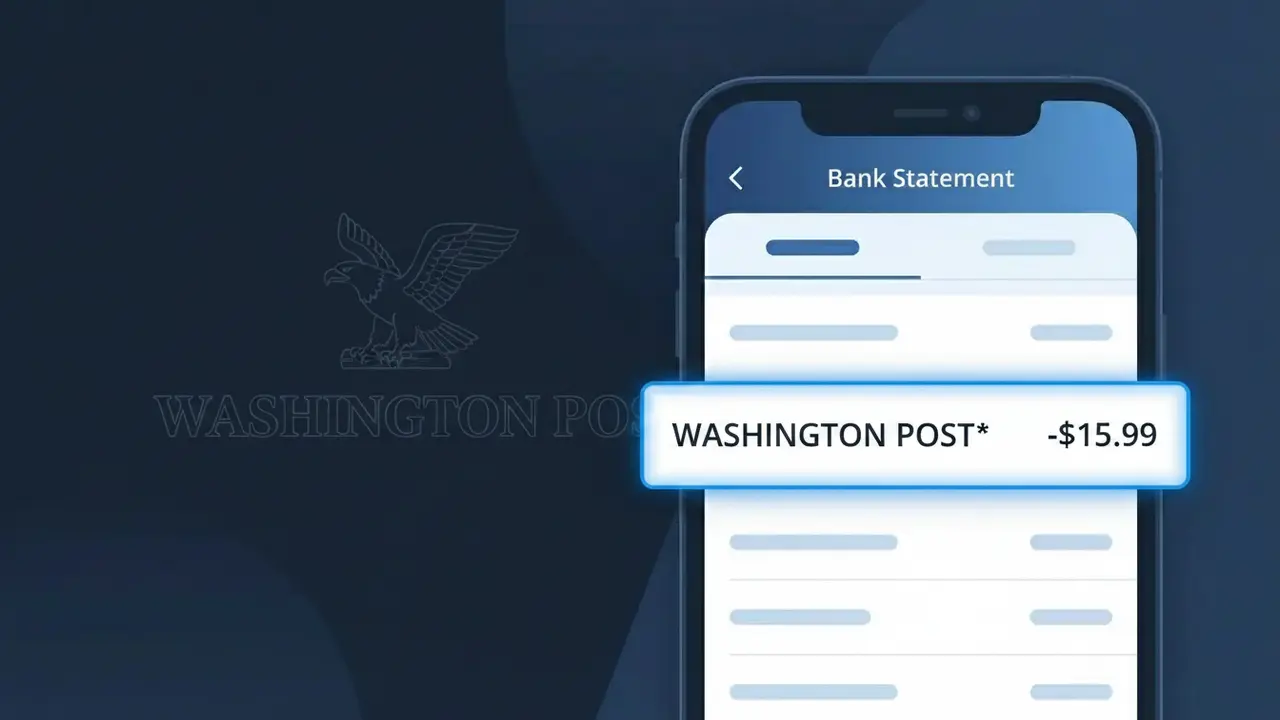
A charge showing WASHINGTON POST* on your bank statement is from The Washington Post, one of America's most prominent news organizations. This charge typically represents a digital subscription to washingtonpost.com, granting access to online articles, newsletters, and other premium content. The asterisk following the descriptor is commonly used by subscription services to indicate a recurring billing arrangement. If you see this charge and don't recall signing up, you may have started a free trial that converted to a paid subscription.
The descriptor WASHINGTON POST* appears on your bank statement because payment processors use abbreviated or stylized versions of a company's name to identify transactions, and The Washington Post registers their billing under this truncated format. The asterisk is a standard convention used in recurring subscription billing to signal that the charge will repeat on a regular cycle, typically monthly or annually. This descriptor is assigned during the merchant account setup process and is what your bank displays rather than a longer or more descriptive label.
Is the WASHINGTON POST* Charge Legitimate or Fraud?
A WASHINGTON POST* charge on your bank or credit card statement is almost always a legitimate billing from The Washington Post for a digital or print news subscription. The asterisk following the name is a standard payment processor formatting convention and does not indicate anything suspicious. Here are the most common reasons you might see this charge:
- You subscribed to a Washington Post digital plan (Basic, Premium, or All Access)
- Your Washington Post free trial period ended and auto-renewal kicked in
- A family member or household resident signed up using your payment method
- You purchased a Washington Post gift subscription that is now renewing
How to Verify the WASHINGTON POST* Charge
- 1
Log into your Washington Post account
Visit washingtonpost.com and sign in. Navigate to 'Manage Subscription' under your account settings to confirm active plans and your billing date.
- 2
Search your email for Washington Post receipts
Search your inbox for 'Washington Post' or 'subscription confirmation.' Washington Post sends email receipts when a charge is processed or a trial ends.
- 3
Check with household members
Ask family members or roommates if they signed up for a Washington Post subscription using your shared payment method without telling you.
- 4
Review your subscription management tools
Check services like Rocket Money or your bank's subscription tracker to see if a recurring WASHINGTON POST* charge has been appearing on a monthly or annual cycle.
- 5
Contact your bank for transaction details
Call the number on the back of your card and ask for the full merchant details behind the WASHINGTON POST* charge, including the date and exact amount billed.
How to Dispute a WASHINGTON POST* Charge
- 1
Act within 60 days of the charge
Most banks require disputes to be filed within 60 days of the statement date. Don't delay if you believe the WASHINGTON POST* charge is unauthorized or incorrect.
- 2
Contact Washington Post customer service first
Reach out to Washington Post support at washingtonpost.com/help or call 1-800-477-4679. They can often issue a refund faster than a formal bank dispute.
- 3
File a chargeback with your bank
If Washington Post cannot resolve the issue, contact your bank or credit card issuer to dispute the WASHINGTON POST* charge as unauthorized or billing in error.
- 4
Request a new card if fraud is suspected
If you never had a Washington Post subscription and see a WASHINGTON POST* charge, request a replacement card to prevent any further unauthorized transactions.
Tips for Managing Washington Post Charges
Set a billing alert so you're notified the moment a WASHINGTON POST* charge posts to your account.
Save your Washington Post subscription confirmation email so you can easily match it to future WASHINGTON POST* charges.
Log into your Washington Post account regularly to review your active plan, renewal date, and stored payment method.
Note whether your Washington Post plan bills monthly or annually to avoid surprise WASHINGTON POST* charges at renewal.
Use a virtual card number for your Washington Post subscription to limit exposure if your card details are ever compromised.
Use WhatIsThisCharge.net to identify related charges that may appear alongside WASHINGTON POST* on your statement.
Frequently Asked Questions About the WASHINGTON POST* Charge
ℹ️ Note
In most cases, a WASHINGTON POST* charge is simply The Washington Post billing you for an active digital news subscription — often a trial that converted to a paid plan. A quick check of your Washington Post account at washingtonpost.com will confirm the charge and give you full control over your subscription.
🔍 Decode this charge instantly
Search our database for WASHINGTON POST* and similar charges.
Decode WASHINGTON POST* →Was this article helpful?