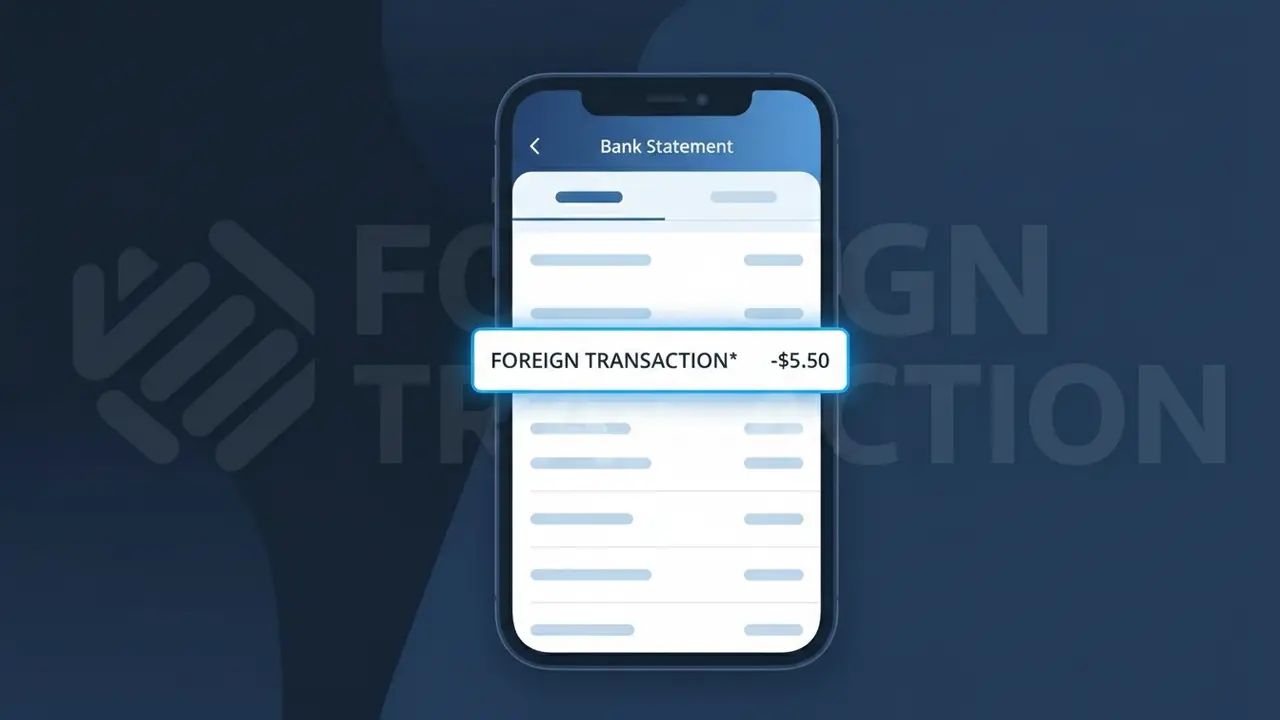
FOREIGN TRANSACTION* Charge (What It Is + Is It Legit?)
✓ LegitimateThe "FOREIGN TRANSACTION*" charge is from Foreign Transaction Fee. Bank fee for international card transaction.
Foreign Transaction Fee
Bank fee for international card transaction.
Category
Banking
Avg. Charge
$3.00
Country
US
Billing Cycle
One-time
Cancel At
N/A
Support
See website
Why this shows on your statement
When your bank processes a purchase made in a foreign currency or through an international merchant, it automatically appends a service fee to your account and labels it "FOREIGN TRANSACTION*" on your statement rather than spelling out the full description "Foreign Transaction Fee." The truncated format exists because banks and card networks like Visa and Mastercard use standardized short-form descriptor fields in their billing systems, which cap the number of characters displayed to cardholders. The asterisk following the descriptor is a common banking convention used to flag the charge as a fee tied to a specific triggering event, in this case an international card transaction, rather than a merchant purchase.
What should you do?
Confirm the international transaction
Review your recent purchase history to identify any transactions made with a foreign merchant or while traveling abroad. The FOREIGN TRANSACTION* charge on your statement is a legitimate fee your bank applies when your card is used for international purchases, so match it to a specific purchase you recall making.
Check your bank's Foreign Transaction Fee rate
Log into your bank account or visit google.com to look up your card's foreign transaction fee policy. Most banks charge between 1% and 3% of the transaction amount as a Foreign Transaction Fee, so verify that the FOREIGN TRANSACTION* amount on your statement aligns with that percentage of your international purchase.
Consider switching to a no-fee card
If you frequently see FOREIGN TRANSACTION* charges on your statement, research credit or debit cards that waive the Foreign Transaction Fee entirely. Many travel-focused cards eliminate this fee, which could save you money on future international purchases or online orders from foreign merchants.
Contact your bank to understand future Foreign Transaction Fees
Reach out to your bank's customer service to ask about any options to reduce or avoid the Foreign Transaction Fee going forward. Some banks may offer account upgrades or alternative cards that do not apply the FOREIGN TRANSACTION* charge, helping you better manage costs on international spending.
Should you be worried?
No, this is a legitimate charge from Foreign Transaction Fee. However, if you did not authorize this charge or cancelled your subscription, you may be eligible for a refund.
Is the FOREIGN TRANSACTION* Charge Legitimate or Fraud?
The FOREIGN TRANSACTION* charge on your bank or credit card statement is typically a legitimate fee assessed by your card issuer — not a merchant — whenever you make a purchase in a foreign currency or with an overseas retailer. This Foreign Transaction Fee is standard practice among many banks and credit card companies, usually ranging from 1% to 3% of the transaction amount. However, if you don't recall any international purchases, it's worth investigating further.
- You recently shopped on an international website billed in a foreign currency
- You traveled abroad and used your card for purchases or ATM withdrawals
- Your card issuer applies a Foreign Transaction Fee even to USD purchases routed through foreign banks
- A family member or authorized user on your account made an international purchase
How to Verify the FOREIGN TRANSACTION* Charge
- 1
Check the charge amount and date
Log into your bank or credit card account and note the exact date of the FOREIGN TRANSACTION* charge. Cross-reference it with any international purchases or travel you made around that time.
- 2
Search your email for international receipts
Look for order confirmations or receipts from foreign merchants around the charge date. Many online retailers outside the US trigger a Foreign Transaction Fee automatically.
- 3
Check with household members
Ask authorized users on your account if they made any purchases from international websites or while traveling, which would generate a FOREIGN TRANSACTION* charge.
- 4
Review your card's fee schedule
Check your card agreement or your issuer's website to confirm whether a Foreign Transaction Fee applies to your specific card and what percentage is charged per transaction.
- 5
Contact your bank
If you still can't identify the source of the FOREIGN TRANSACTION* charge, call the number on the back of your card and ask your bank to provide details about which original transaction triggered the fee.
How to Dispute a FOREIGN TRANSACTION* Charge
- 1
Act within 60 days
Most banks require disputes to be filed within 60 days of the statement date. Don't delay if you believe the FOREIGN TRANSACTION* charge was applied in error or stems from fraud.
- 2
Contact your card issuer first
Call your bank and explain that you are disputing the FOREIGN TRANSACTION* charge. Ask them to identify the underlying transaction and request a fee waiver if the charge was unexpected or incorrectly applied.
- 3
File a formal chargeback if needed
If your bank confirms the underlying transaction was unauthorized, file a formal chargeback. The Foreign Transaction Fee associated with that fraudulent transaction should also be reversed.
- 4
Request a new card
If the FOREIGN TRANSACTION* charge is linked to fraudulent activity on your account, ask your bank to cancel the compromised card and issue a new one to prevent further unauthorized charges.
Tips for Managing Foreign Transaction Fee Charges
Set up transaction alerts so you're notified instantly when a FOREIGN TRANSACTION* fee is applied to your account.
Keep receipts from international purchases to easily match them against any FOREIGN TRANSACTION* charge on your statement.
Upgrade to a no-foreign-transaction-fee card to eliminate the Foreign Transaction Fee entirely on international spending.
Review your monthly statement around travel dates — Foreign Transaction Fees often appear days after the original purchase posts.
Use a credit card with fraud protection abroad; disputed charges including Foreign Transaction Fees are easier to recover.
Use WhatIsThisCharge.net to identify related charges that may appear alongside FOREIGN TRANSACTION* on your statement.
ℹ️ Note
In most cases, the FOREIGN TRANSACTION* charge is a routine Foreign Transaction Fee automatically applied by your card issuer — not a scam. If you recently shopped internationally or online with an overseas retailer, this small percentage-based fee is expected and your account is likely secure.
Questions and answers
Was this page helpful?
Community Reports (0)
0 votesNo votes yet — be the first to report on this charge!
Have you seen this charge? Help others by voting:
Community Comments (0)
No comments yet. Be the first to share your experience!
Share your experience
Your email is only used to verify your comment and will never be shown publicly.
Search Another Charge
Popular Charges

Amazon Marketplace
AMZN MKTP US
Netflix
NETFLIX *SUBSCRIPTION
Netflix
NETFLIX.COM *
Apple
APPLE *SUBSCRIPTION
Apple
APPLE.COM/BILL
Related Charges
Need to dispute this charge?
Generate a professional dispute letter in seconds with our AI tool.
Open Charge AssistantCommunity Verified
Real user reports
Free to Use
Always free to check
Secure & Private
Your data is safe
Help Millions
48K+ charges identified